Everything comes to he who waits - PHILIPS
Everything comes to he who waits - PHILIPS
Innovation does not always provide immediate results. Sometimes one has to wait for a long time in order to obtain economic benefits. And the more ahead of its time an idea is, the longer it may take to catch on.
This is why large companies often decide to diversify their investments in R+D+I. In strategic terms, it is better for them to have options open in future business areas, even if they have to wait for the results and even if some opportunities never arise.
One of the most extreme cases that illustrates this idea features Philips, the firm famous for its lighting products.
This Dutch company was founded in 1891 by Gerard Philips and his father Frederik in order to manufacture an invention that, at the time, had already been a great success for 12 years: the electric light bulb.[^1]
Artificial light was, in the late nineteenth century, an invention that makes the emergence of the Internet in our lives look completely banal by comparison.
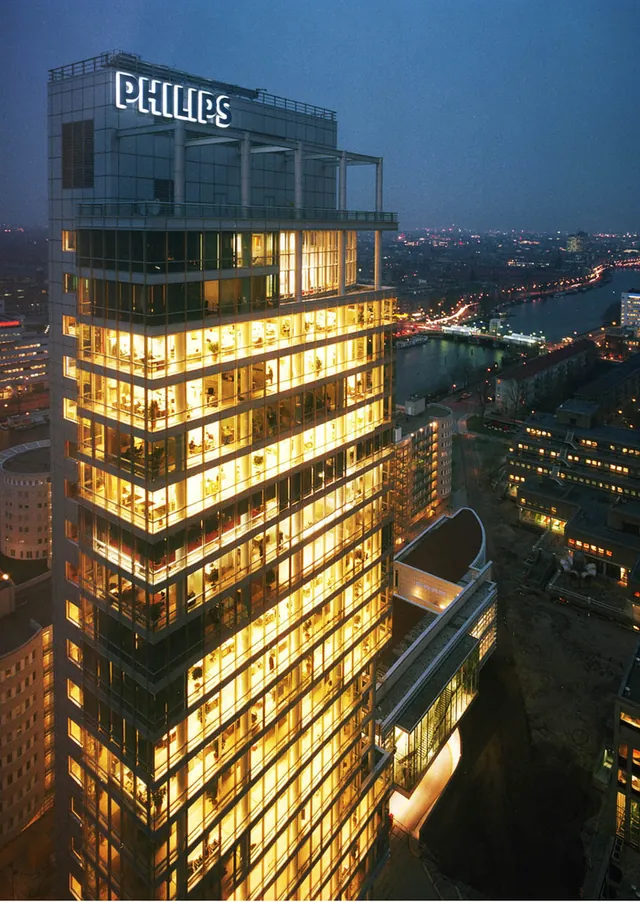
The Philips family saw the potential of the light bulb immediately, even though they did not understand the real size to which the business could grow until they recruited the cleverest member of the family, Anton Philips.
It was he, the younger brother, who saw that they needed to invest in engineers and diversify production in order to stay ahead of other competitors.
In the 1920s and 1930s, they introduced products onto the European market that are now well established, such as radios, vacuum cleaners and electric shavers.
However, not all their products were so well received by the market.
In July 1936, while Spain was occupied with the first chapters of its civil war, the Philips research laboratory magazine published an article on the advances achieved using neon lights to grow plants.[^2]
The article scientifically demonstrated that efficient artificial illumination could be applied to farming in enclosed areas, with good results.
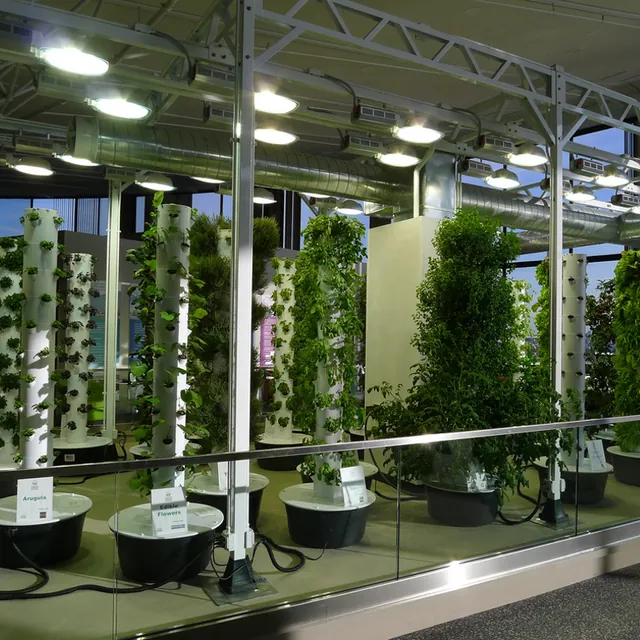
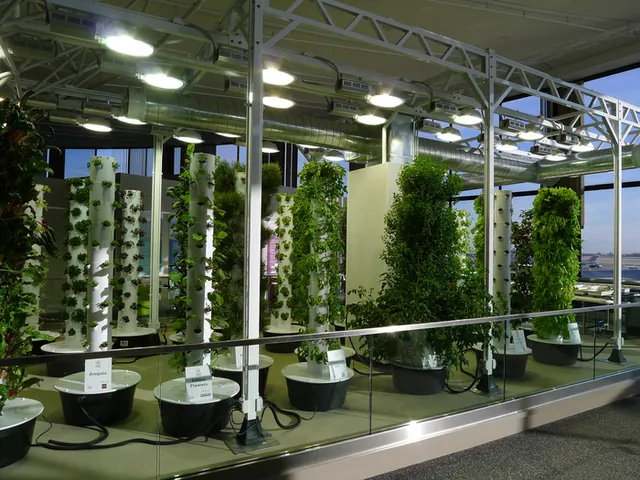
At the time, the idea did not arouse too much interest. Today, however, it is known as “city farming” and is almost always mentioned alongside concepts such as smart cities, sustainability and resilience.
What has happened during the last 80 years? Why didn’t the idea succeed before?
Firstly, it was not necessary. Traditional agricultural methods produced sufficient food to supply the most advanced societies.
In fact, the two concepts city and farm were not linked until the end of the 1960s in the United Kingdom. This was due to the hippies, who thought that adding farm animals and small urban vegetable farms was an excellent idea for their communes.
A few years later, the punks announced that the only crests seen at home would be their own, and the experiment came to an end.
Industry, however, continued investigating, albeit in a relaxed manner.
The main problem was that the fluorescent lights of the time did not provide the desired amount of light. They both used and wasted too much energy, they could not be programmed, and they were too expensive to produce and install if they were only to be used to grow lettuce.
However, three letters changed the game: LED.
This new technology consumed 75% less energy than fluorescent lights and lasted 10 times longer. It did not fade, the lights could be programmed, they occupied less space and concentrated light more effectively.
In short, LED lights represented a quantum leap in terms of efficiency.
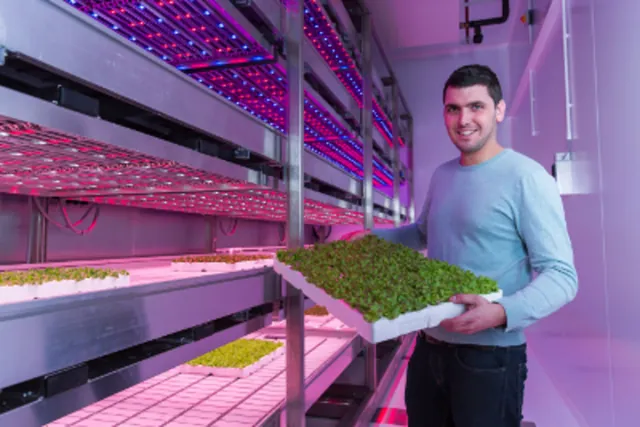
All of this, combined with the marked rise in urban populations and the reduction of land available for farming, motivated twenty-first-century entrepreneurs to create vertical farms, where cultivation takes place inside warehouses.
At last, the great-grandchildren of the Philips family could begin to reap the benefits of that almost-forgotten research.
According to the United Nations, by 2050 the world population will have grown by 2.5 billion people, and agricultural production volumes will need to increase by 70% in order to satisfy their requirements.
Today, 80% of all cultivatable land is already being used.
With this dismal scenario for humanity, the solution lies with initiatives such as those of Green Sense Farms, a company located on the outskirts of Chicago.
The company has installed 7,000 Philips LED light bulbs inside an enormous 30,000 m² warehouse in order to produce around 4,000 boxes of vegetables a week.
These vegetables are grown under ideal lighting conditions, in terms of both quality and quantity, without pesticides and out of reach of any inclement weather.[^3]
Philips states that its lights can be used to grow a lettuce in only 38 days, while traditional methods take between 65 and 130 days, depending on the variety and the time of year.
Are we ready to eat lettuce made in a factory?
Philips believes so.
In 2014 and 2015, the city farming division of the company tripled its staff numbers and predicted enormous investments for the immediate future.[^4]
The aim is to create modular and scalable systems that include illumination, irrigation and fertilisation in order to simplify their products.
Some of Philips’ clients state that investment returns are seen within one year.
And if you still have doubts about the viability of this new business area, the Japanese branch of General Electric has just reached an agreement with a horticultural business group on the construction of a giant vertical farm.
Its aim is to rival Philips’ market leadership from the very start of this new initiative.[^5]
The conclusions are obvious.
Sources
[^1]: Paul Israel, Edison: A Life of Invention. John Wiley & Sons, 2000.
[^2]: J.W.M. Roodenburg and G. Zecher, “Irradiation of plants with neon light”, Philips Technical Review, July 1936.
[^3]: “The light fantastic”, The Economist, 17 May 2014.
[^4]: Corine Iozzio, “A Farm on Every Street Corner”, Fast Company, April 2015.
[^5]: “The Future of Agriculture? Indoor Farms Powered by LEDs”, GE Reports, 18 September 2014.
[^6]: “The latest news in horticulture”, Philips, updated 14 September 2015.