Tryton + Giswater: the best formula for water management
Quick summary
Giswater is designed to analyse and plan water networks, while Tryton adds the business-management capabilities that the specialised tool does not provide. Because both platforms rely on technologies such as PostgreSQL and Python, they can be integrated to support field-work control, invoicing, commercial margins and incident management.
Contents
When two good open source technology platforms are combined, the results can be extraordinarily beneficial for users. This was the main conclusion reached by the more than 50 representatives of water companies, engineering firms and businesses linked to the water cycle who attended the first Giswater Conference held in Mataró.
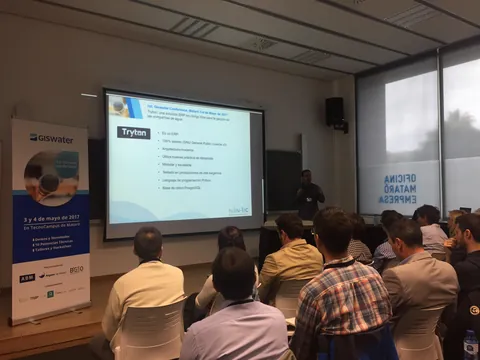
The event aimed to present the new features introduced in version 2.0 of Giswater, a highly specialised tool for designing and analysing sewage and drinking-water supply networks. However, Giswater does not include any module or functionality aimed at the business activity behind integrated water-cycle management. For this reason, the organisers invited us to explain how easy it is to integrate Tryton into the Giswater environment in order to multiply its potential. It is not the same to have a tool that allows you to design a network as to have another that allows you to run a business based on network design.
Tryton and Giswater share much of their technological structure, since both are based on PostgreSQL databases and programmed in the same language, Python.
Carles Hilario’s presentation focused on the features offered by Tryton for service companies, highlighting aspects such as field-work control, invoicing, commercial-margin calculation and incident management. The presentation attracted the attention of drinking-water concessionary companies, as well as various engineering firms that are also openly embracing free technologies.
Frequently asked questions
What role does Giswater play in water-cycle management?
Giswater is a specialised tool for designing and analysing sewage and drinking-water supply networks.
What does Tryton add that Giswater does not provide?
Tryton covers the business side of the activity, including field-work control, invoicing, commercial-margin calculation and incident management.
Why can Tryton and Giswater be integrated?
They share much of their technological foundation: both platforms use PostgreSQL databases and are programmed in Python.
Related articles
ERP and Business
Phases of ERP implementation
A successful ERP rollout involves more than configuring software: it requires clear business goals, a workable plan and people who are ready for change. NaN-tic’s five-stage approach brings together consultancy, data migration, user training and rehearsals before go-live. A review after launch leads into ongoing support and continuous improvement.

ERP and Business
ERP: Does it adapt to you or do you conform with it?
Fitting a business into standard software is not the same as improving its processes; that takes analysis and collaboration with consultants. Tryton’s modular structure allows an ERP to be tailored without building an entirely new system. Keeping customisations up to date and adding functionality as needs change are essential parts of that approach.

ERP and Business
ERP ROI: Calculating the benefits of implementing an ERP
ERP return on investment starts with measurable goals and a baseline collected before implementation. A meaningful assessment weighs savings against project costs and employees’ time, while recognising benefits that are harder to quantify. The ROI formula provides a financial measure, and ongoing KPI comparisons show whether the wider productivity and business objectives are being met.