Smart stock management
Quick summary
A machine-learning system compares actual stock management with an optimised simulation to calculate thresholds for demand, investment, prices, volumes and stockouts. Integrated with the company’s ERP, it continuously updates those parameters from real data and experience, helping reduce inventory and time purchases more accurately.
Contents

Do not overstock or understock any product in your store. Never pay your suppliers above the minimum purchase price. Buy only on the most appropriate day to do it. It sounds good, right?
There are companies that already have an intelligent stock management system and have managed to optimize their warehouses and distribution centers to the maximum. The secret lies in a technology called machine learning which we have been offering companies from many different sectors in recent months. With the following video you can get a very precise idea of how this innovative intelligent stock management system works.
The concept
The concept is relatively simple. It is about comparing the actual management of the stocks made by the company with what would be the most optimal possible. How is it done?
We start by creating what we call a retroactive simulation. This means that we analyze the data accumulated by the company in recent months to establish what would be the optimal parameters in demand planning, investment in stocks, price, volume, stock ruptures... Our system creates a complete virtual graphical simulation customized to the parameters required by the customer.
This is an example of this simulation:
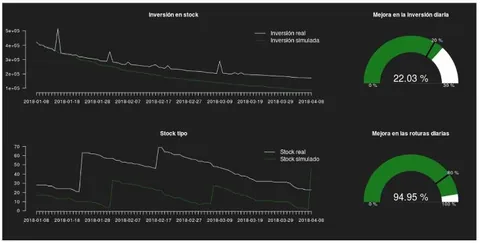
This information is essential, because it automatically sets the minimum and maximum thresholds on which decisions must be made that affect the stock. Both globally and for each product or concept that interests us.
Next, we compare these 100% optimized virtual results with the real results of the company. The contrast is usually surprising and shows a large margin for improvement in stock management. We show it through fully comprehensible graphics that can be easily consulted via the web.
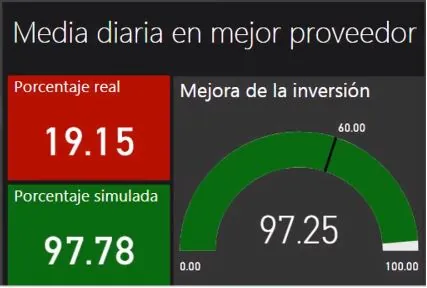
In addition, as this machine learning system is integrated with the company's ERP, it automatically collects the data and recalculates and learns from real experience. This guarantees that the optimal parameters are kept perfectly up to date without the need for company personnel to intervene.
The benefits
The benefits offered by this system can be huge, especially in those companies where rotation and stock management in the warehouse are critical, or in those where the margins on purchases from manufacturers and suppliers are very low.
The benefits can be summarized in:
- Automated demand planning
- Perfect adaptation of stocks to demand
- Reduction of investment in stock
- Detection of changes in customer behaviour to avoid churn
- Segmentation of customers and products
- Integration with any ERP
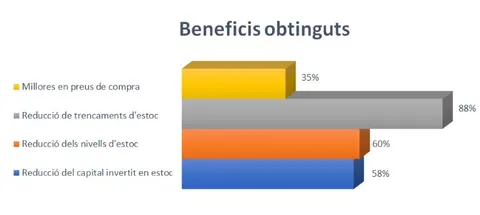
By way of example, the specific benefits obtained by a company in the pharmaceutical sector are described here.
More information
If you want more information about our intelligent stock management system, contact us and we will analyze its potential for your company.
Frequently asked questions
How does intelligent stock management work?
It compares the company’s actual management with a retrospective simulation based on data from previous months. This comparison is used to calculate optimal parameters and thresholds for demand and inventory decisions.
Which data and parameters does the system analyse?
It analyses demand planning, inventory investment, price, volume and stockouts, both globally and for each product or relevant concept.
How does it integrate with the company’s ERP?
It automatically collects data from the ERP and compares actual management with the simulation results. The optimal parameters can therefore be recalculated and kept up to date as the system gains experience.
What benefits can it bring to warehouse management?
It can automate demand planning, align inventory with demand, reduce investment in stock, detect changes in customer behaviour and segment customers and products.
Related articles
ERP and Business
ERP ROI: Calculating the benefits of implementing an ERP
ERP return on investment starts with measurable goals and a baseline collected before implementation. A meaningful assessment weighs savings against project costs and employees’ time, while recognising benefits that are harder to quantify. The ROI formula provides a financial measure, and ongoing KPI comparisons show whether the wider productivity and business objectives are being met.

ERP and Business
Do you want more efficiency for less cost while improving business relationships?
EDI integration brings standardised electronic document exchange into the ERP, reducing manual administration, paper use and human error. More reliable accounting data and traceable exchanges also support financial planning and faster, safer B2B communication. Examples from Bon Preu Esclat and Nestlé show how these benefits apply to invoices, orders and inventory operations.

ERP and Business
ERP: Does it adapt to you or do you conform with it?
Fitting a business into standard software is not the same as improving its processes; that takes analysis and collaboration with consultants. Tryton’s modular structure allows an ERP to be tailored without building an entirely new system. Keeping customisations up to date and adding functionality as needs change are essential parts of that approach.
